


This series of graphic novel memoirs by and about civil rights activist and statesman, John Lewis, is truly worth picking up for readers in 7th grade and up as well as adults. They are all excellent memoirs by Lewis about different marches that he participated in, bringing the spirit and the horrors of the American civil rights movement in the late 1950s and early 1960s to life.
March: Book One begins with a glimpse ahead of what is to come in the book series with the account of the march to Selma, before flashing to present day John Lewis awaking on the morning 44th President, Barack Obama, is to be sworn in to office. This first graphic novel goes back and forth between Lewis preparing for the inauguration day and telling the story of his childhood, reliving his experiences caring for chickens on his family’s land, going to school on segregated busing, and the everyday minor prejudices and racism he experienced as a person of color. Lewis recounts the events of 1955 with Brown vs. The Board of Education trials condemning school segregation, the racially motivated killing of young Emmitt Till, and the bus boycotts that resulted from Rosa Parks’s arrest after refusing to move seats.

(Lewis & Aydin, 2013, p.58)
The memoir continues to build momentum as Lewis joins the Student Nonviolent Coordinating Committee (SNCC). He participated in workshops to learn about ways to protest nonviolently together. These workshops prepared the group to begin diner sit-ins in 1959 at segregated establishments in downtown Nashville, TN. Over the course of 2 years, the group participated in many sit-ins, often met with violence and mistreatment, though the group never responded back with violence.
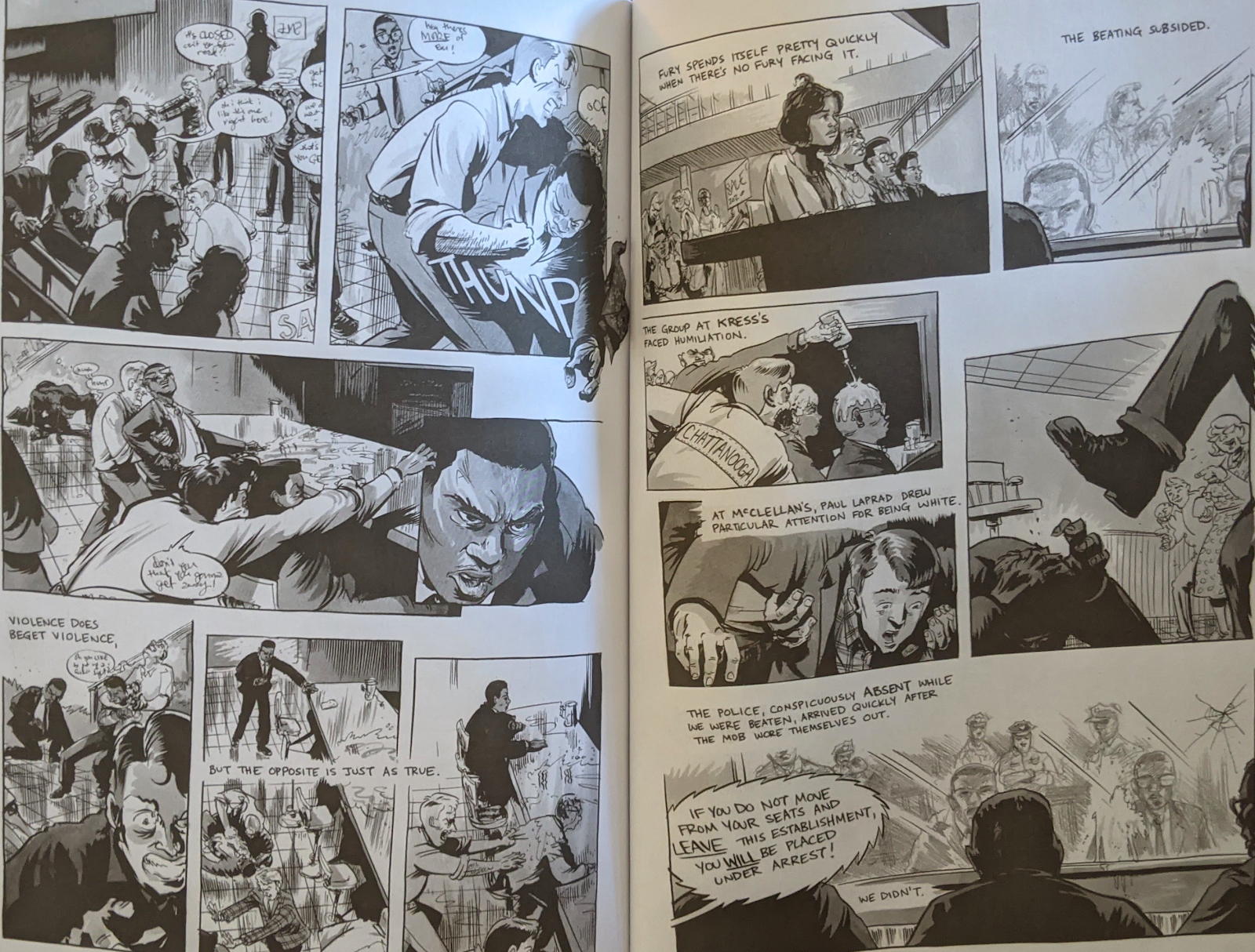
(Lewis & Aydin, 2013, p. 100-101)
Many were jailed, violence spread to private property, and Martin Luther King, Jr. pressed the mayor and country about the issues as SNCC continued their protest sit-ins and eventually had thousands march downtown to city hall. Their efforts helped to begin change and the mayor called for integration at lunch counters.
March: Book Two jumps right back into the flashing back and forth between Obama’s inauguration and sit-ins at fast food restaurants & cafeterias, showing how these sit-ins eventually escalate to unbelievable cruelty through fumigation and extreme violence. The same occurs when SNCC expands their non-violent protests to segregated movie theaters. The organization decides to also focus on the Boyton vs. Virginia Supreme Court case that outlawed segregation and discrimination on public buses by becoming Freedom Riders in 1961 through Alabama and Mississippi. As suspected, they are again met with extreme violence, regardless to the law, with some buses firebombed because they are riding them.

(Lewis & Aydin, 2015, p. 44-45)
Cooperation between the police and the Ku Klux Klan leads to fear, intimidation, and more violence at bus terminals as well as mass arrests of those participating in the rides. Prominent figures of the movement including Martin Luther King, Jr. and politicians such as Robert F. Kennedy & George Wallace, Jr. are shown as the violence spreads and increases, escalating into homes being shot at, churches being attacked, and beatings in the streets. More marches for the enforcement of civil rights happen and Martin Luther King, Jr. is arrested in Birmingham, writing his now famous letters from jail.
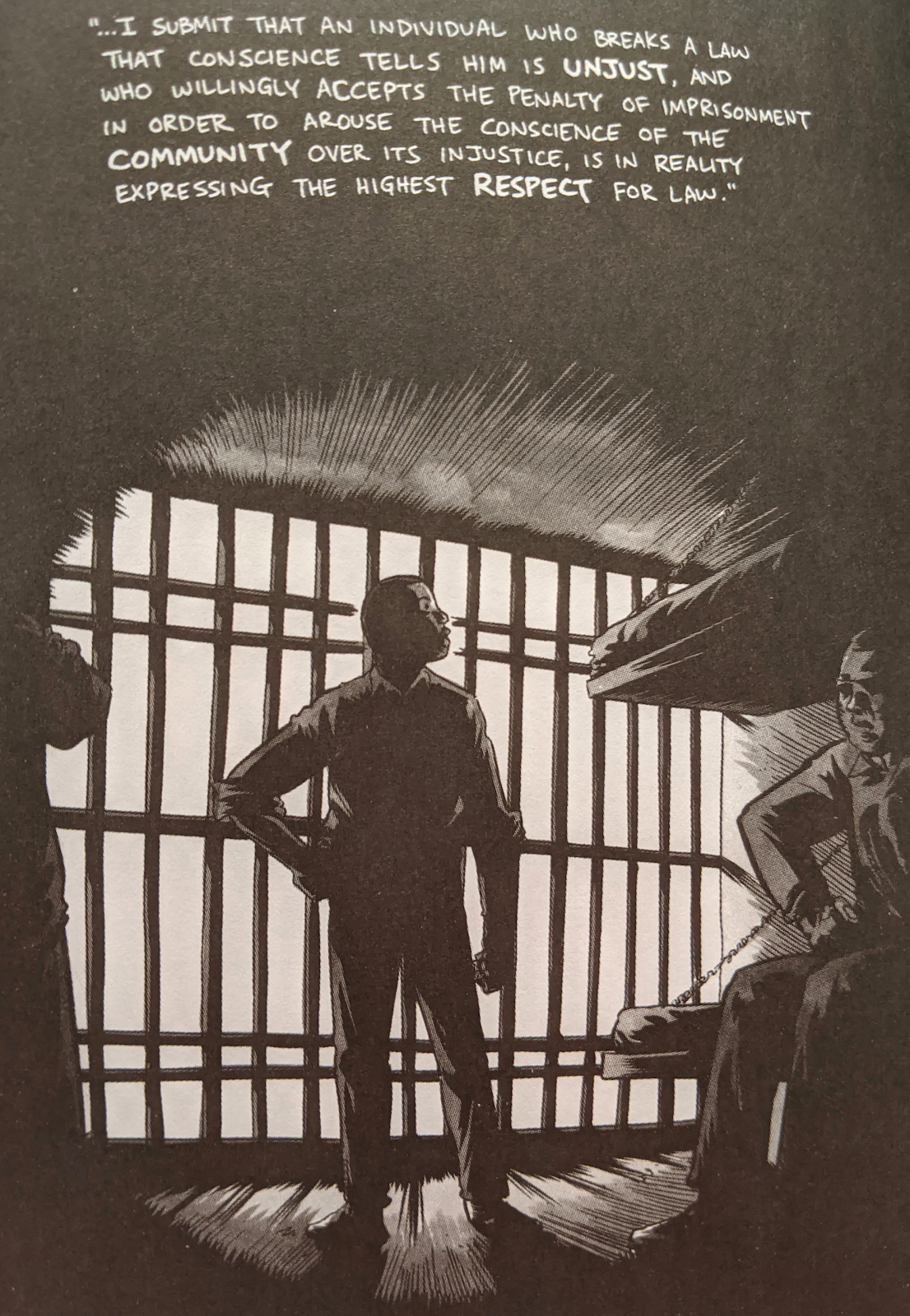
(Lewis & Aydin, 2015, p. 130)
Eventually in 1963, president John F. Kennedy calls for representatives of the movement to convene for a meeting to discuss a civil rights bill and discuss a planned march on Washington by the movement.
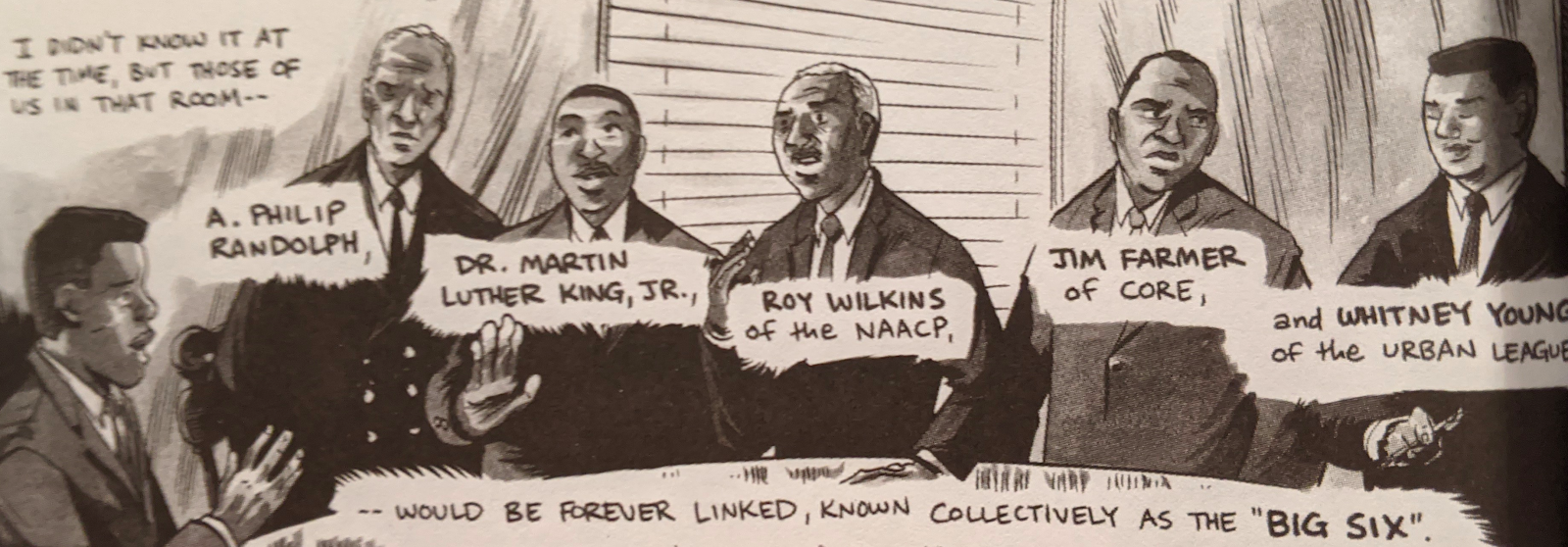
(Lewis & Aydin, 2015, p. 150)
Much of the rest of book two centers around the planning and events for the March on Washington for Jobs and Freedom of 1963, highlighting the important participants, organizers, and speeches that take place, including a moving speech by John Lewis as well as Martin Luther King, Jr’s I Had a Dream speech.

(Lewis & Aydin, 2015, p. 172-173)
March: Book Three goes into the height of the violence in response to the movement growing. In this book we see the Birmingham church bombing that killed 4 little, black girls. President Kennedy is assassinated, and Lyndon Johnson becomes president. Students disappear and are found murdered. Any peaceful protests are met with cruel beatings and attacks by police and white citizens against the movement. There are even killings of children in the streets. Civil rights members are jailed. By highlighting these events, Lewis is able to really visually and narratively draw on the emotions of the reader to show just how racist the country was during this time period and also how brave the civil rights movement members were, always reacting peacefully in the face of hate.

(Lewis & Aydin, 2016, p. 8-9)
In this final book of the series, Lewis shows how SNCC begins to focus on the rights of black Americans to vote, since leaders are not enforcing laws to protect black citizens. Though they were legally allowed to, Lewis highlights the inequalities to trying to register to vote as a black American where they were subjected to ridiculous tests that white Americans did not have to go through.
In Selma, Alabama, protest numbers grow and grow. President Lyndon Johnson is able to push through the Civil Rights Act of 1964, but without voting rights, black Americans still feel like their hands are tied. Daily marches occur at the courthouse and black Americans wait in line for the opportunity to register to vote. Teachers boycott and join in. Students join in. Malcolm X is assassinated. In 1965, a march in Selma was organized where the movement would walk to Montgomery in protest, wanting the fair right to vote for all Americans. Lewis describes how on March 7, 1965, the group was brutally beaten as they made their way by law enforcement in what became known as Bloody Sunday, an act that had him hospitalized.
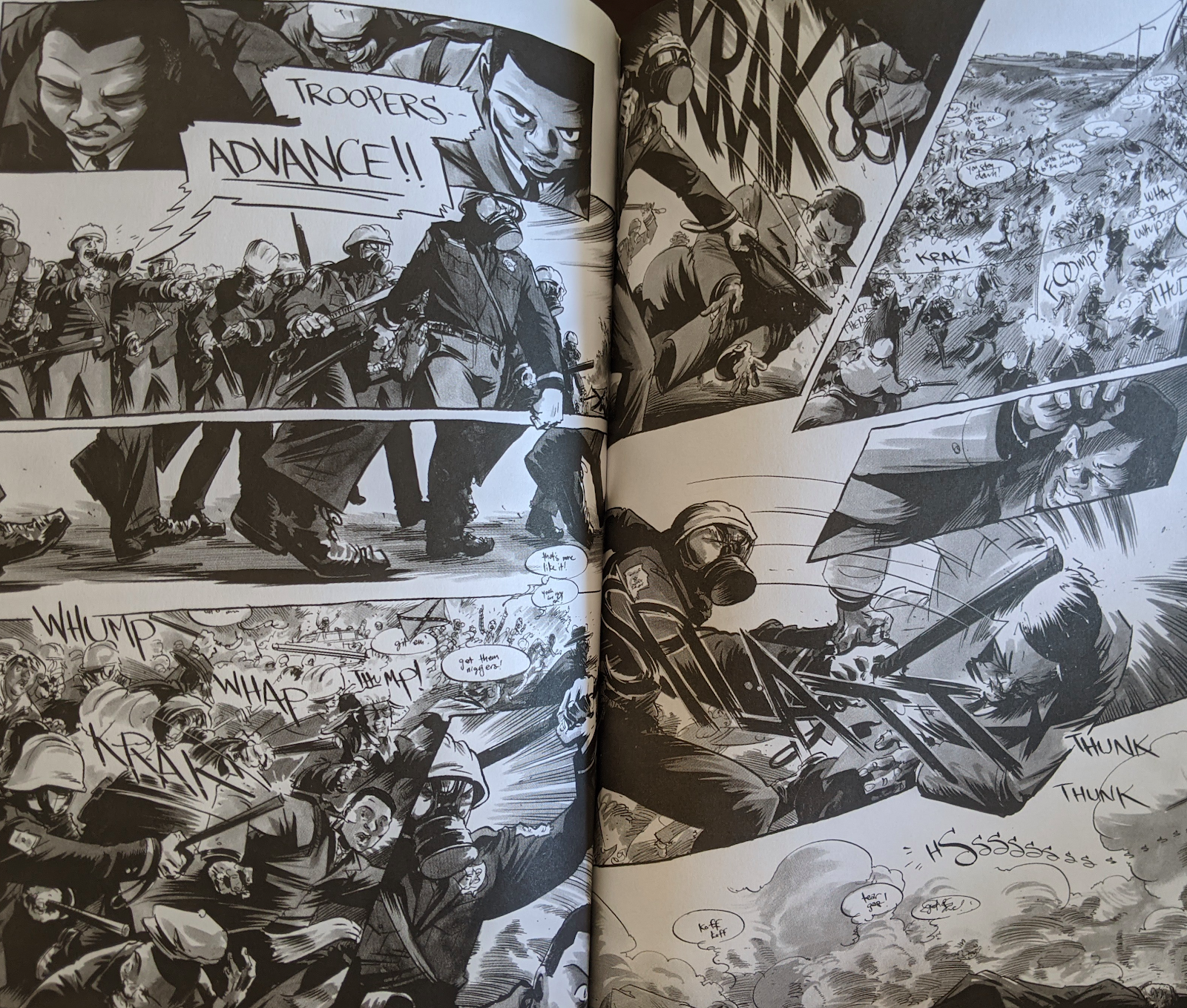
(Lewis & Aydin, 2016, p. 200-201)
Despite the violence, the group continues to attempt their March multiple times, finally able to make the trek on March 21, 1965. That following August, President Johnson was able to pass the Voting Rights Act of 1965. His speech at the signing ceremony is highlighted in the last few pages of the book, and includes, “The vote is the most powerful instrument ever devised by man for wreaking down injustice and destroying the terrible walls which imprison men because they are different from other men,” (Lewis & Aydin, 2016, p. 242).

(Lewis & Aydin, 2016, p. 242-243)
Having completed reading this series as election day approaches in 2020 (tomorrow), I can’t help but feel emotionally moved by this book series. These books so well display the struggles of black America during the civil rights movement; the courage and bravery they faced as they dealt with such harsh words, fists, and sometimes death daily. I think tweens, teens, and even adults would be inspired by these graphic novel memoirs, and could use them to compare the protests of today for equal rights and treatment. A very, powerful series indeed that I highly recommend!
Non-fiction read-alikes and/or pairings:
Child of the Dream by Sharon Robinson: Set in 1963, this memoir by the daughter of baseball legend, Jackie Robinson, shares her childhood experiences coming of age during the civil rights movement. (5th to 8th grade)
Because They Marched: The People’s Campaign for Voting Rights That Changed America by Russell Freedman: Newberry author, Russel Freedman’s, book is a great accompaniment to Lewis’s graphic novels, full of black and white photographs of the boycotts and marches surrounding voting rights for black Americans in Alabama. The photographs bring the past to life and the text highlights the events surrounding these marches followed by a timeline, extensive source notes, bibliography, and index. (7th grade+)
Oh, Freedom!: Kids Talk About the Civil Rights Movement with the People Who Made It Happen by Casey King: A collection of 31 interviews done by 4th grade students from a Washington classroom with everyday people that lived through the civil rights movement, this book is perfect for showing children how regular people can be the force behind change. (4th to 8th grade)
Extraordinary People of the Civil Rights Movement by Sheila Hardy & P. Stephen Hardy: Part of the Extraordinary People book series, this book highlights 61 key figures of the civil rights movement, Included are black and white photographs, each person’s activist years, and text profiling each individual with their involvement. A glossary, index, and extensive list of additional resources are included in the end pages. (9th grade+)
Trouble Maker for Justice: The Story of Bayard Rustin, The Man Behind the March on Washington by Jaqueline Houtman: Biography about Bayard Rustin, an openly gay black man that was a nonviolent civil rights activist throughout his life, influenced by Gandhi’s teachings and the Quaker religion. He was instrumental in promoting nonviolent protests, mentored Martin Luther King, Jr., and organized the March on Washington for Jobs and Freedom. (9th grade+)
Fiction read-alikes:
Night on Fire by Ronald Kidd: A 13 year old Alabama girl living in 1961 witnesses the Freedom Riders bus protests. She slowly acknowledges her prejudice as she witnesses racism in action around her in the community. (5th to 8th grade)
Revolution by Deborah Wiles: Part of the Wiles’s Sixties Trilogy, this historical fiction second installment focuses on the civil rights movement during 1964 Mississippi. A young white girl’s and a young black boy’s lives intersect as they witness acts of racism. (7th to 10th grade)
Freshwater Road by Denice Nicholas: A black Detroit college student living a most sheltered life travels to 1964 Mississippi to help register black Americans to vote and confronts the extreme racism of the time. (9th grade+)
Lies We Tell Ourselves by Robin Talley: With alternating narration, two girls on the opposite sides of the civil rights movement (white and black) attend one of the first high schools to have racial integration. Partnered in class on a group project, a change in heart occurs as romantic feelings bloom during a time of deep racism and lack of LGBTQ acceptance . (9th grade+)
For resources on the civil rights movement, some YouTube videos that may be educational for tweens and teens include Biography’s March from Selma to Montgomery, History’s Martin Luther King, Jr.'s "I Have A Dream" Speech, and WatchMojo’s History of the Civil Rights Movement. Also, the Birmingham Civil Rights Institute’s (BCRI) website includes an oral history project of digitalized interviews, and PBS has documentary features/snippets focused on the civil rights movement on their Black Cultural Connection section. Educators can access a timeline of the movement on History’s website, access teaching kits at Junior Scholastic, and the National Civil Rights Museum has a few interactive e-learning activities available concerning the bus boycotts and diner sit-ins. Additional information on the people and history of the civil rights movement as well as SNCC can be found at the following websites:
John F. Kennedy Presidential Library and Museum. (2020). Civil rights movement. https://www.jfklibrary.org/learn/about-jfk/jfk-in-history/civil-rights-movement
Library of Congress. (2020). The civil rights act of 1964: A long struggle for freedom. https://www.loc.gov/exhibits/civil-rights-act/civil-rights-era.html
The Martin Luther King, Jr. Research and Education Institute. (2020). Student nonviolent coordinating committee (SNCC). Stanford University. https://kinginstitute.stanford.edu/encyclopedia/student-nonviolent-coordinating-committee-sncc
University of Washington. (2020). Mapping American social movements project: SNCC history and geography. https://depts.washington.edu/moves/SNCC_intro.shtml
The U.S. National Archives and Records Administration. (2020). African American heritage: The student nonviolent coordinating committee (SNCC). https://www.archives.gov/research/african-americans/black-power/sncc
The following resources may be of use for learning more about the life and achievements of John Lewis:
Elliott, D. (2020). Civil rights leader John Lewis never gave up or gave in. NPR. https://www.npr.org/2020/07/19/890796423/civil-rights-leader-john-lewis-never-gave-up-or-gave-in
PBS. (2020). John Lewis: Get in the way. https://www.pbs.org/show/john-lewis-get-in-the-way/
SNCC. (2020). John Lewis. SNCC Digital Gateway. https://snccdigital.org/people/john-lewis/
TIME. [TIME]. (2017, Jan 15). John Lewis: The Selma to Montgomery marches [video]. YouTube. https://www.youtube.com/watch?v=DRwnXUbJdfg
Wallenfeldt, J. (2020). John Lewis: American civil rights leader and politician. Encyclopædia Britannica. https://www.britannica.com/biography/John-Lewis-American-civil-rights-leader-and-politician
March: Book One is a 2014 Corretta Scott King Honor Book and received a special recognition from the 2014 Robert F. Kennedy Human Rights Awards. March: Book Two won the 2016 Eisner Award for Best Reality Based Work. March: Book Three won the 2017 Corretta Scott King Award, the 2016 National Book Award for Young People's Literature, the 2017 Eisner Award for Best Reality Based Work, the 2017 Micheal L. Printz Award, the 2017 YALSA Award for Excellence in Nonfiction, and the 2017 Robert F. Sibert Informational Book Medal. Starred reviews for all three books can be found at Kirkus, Publisher’s Weekly, and The Horn Book.
References
Lewis, J. & Aydin, A. (2013). March: Book one. Top Shelf Productions.
Lewis, J. & Aydin, A. (2015). March: Book two. Top Shelf Productions.
Lewis, J. & Aydin, A. (2016). March: Book three. Top Shelf Productions.


